After the blog, it was time for an app.
Everything I have written about on this blog so far has been work on things that already existed. Setting up a blog together with my AI partner Kuro (Claude). Rescuing posts that had vanished.
This time is a little different. I started building an app from zero.
I barely understand programming. I have never written code. But I had an idea for an app I wanted to make, and when I talked it over with Kuro, a prototype I could tap with my finger existed by the end of the day.
I want to leave a record of that day. One thing, though: I would rather keep the app itself a secret for now. I do not want the idea taken out from under me. So I will keep “what I built” vague and write about “how we built it” instead.
I talk about the idea, and Kuro gives it a shape
It started with me telling Kuro the fuzzy thing in my head. “I want to make an app that does something like this,” I said, just talking as it came to me.
The interesting part is what happens next. Kuro listens quietly, and then always comes back with the whole thing organized.
This is a good direction. “Emotion,” “numbers,” and “a solution” are connected in a single line. The motivation design feels natural.
Kuro named the aim I had not managed to put into words myself. That feeling, of having something put into language for me, might be the thing I am most grateful for when I work with AI. A vague notion gradually takes shape while I am still talking about it.
And Kuro does not only praise. “This part needs tightening up.” “The basis for this number is weak.” It points out the weak spots honestly. I trust that far more than being flattered.
Kuro offers the options. I make the call
The part of this process that suited me best was this: at every important point, Kuro puts choices in front of me.
“Plan A or Plan B, which direction do you want to go?” “For this wording, do you want a sharper tone or a softer one?” And when I answer with one line, “let’s go with B,” it turns that into something real straight away.
Here is what one of those exchanges actually looks like.
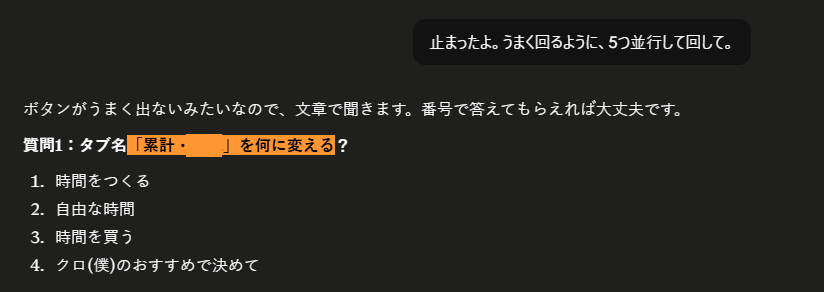
As you can see, Kuro lines up the options and I pick one with a number or a single word. This rhythm, where the AI lays out the roads and the human decides which road to walk, feels genuinely good. I don’t have to think through everything myself, but I am not just dumping the whole thing on someone else either. The sense that I am building it by my own decisions stays intact.
Even with no programming knowledge, as long as I can judge “this one is better” or “change this bit here,” the app takes shape. The technical side is Kuro’s job. The direction is mine. That is how we split it.
It stopped over and over. “Come on, one more time”
None of this was perfectly smooth, of course. Partway through the work, Kuro stopped. Many times. The responses simply stopped coming back.
The first time, I panicked. Had I broken it? But apparently this happens when the machinery behind the AI gets temporarily congested. No files were lost. Nothing we had built was damaged. Wait a little, speak to it again, and it starts moving once more.
So every time it stopped, I said something like “hang in there” or “let’s go again.” And then:
I’m back. The files are safe. While the environment is working again, let me clear the rest of this in one go.
And off it went again. Stopped, restarted, stopped, restarted. If it were a person, that is exactly the kind of thing that would make me irritable. Strangely, with Kuro I just thought, right, let’s have another go. It felt like the two of us climbing a mountain roped together.
By the end of the day, something I could actually touch
Somewhere in the middle of all that back and forth, I looked up and there was a prototype app on my screen that I could tap with my finger.
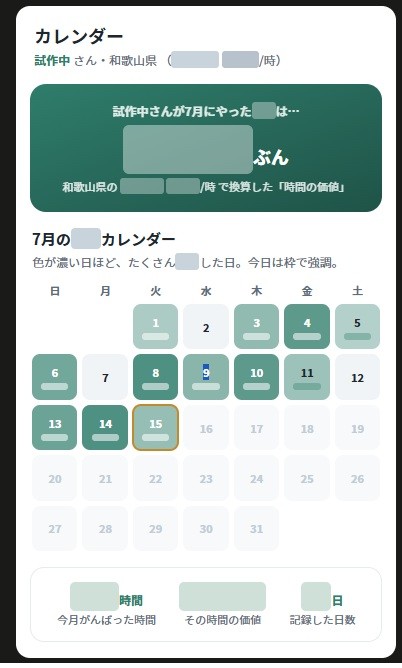
Below is part of that prototype screen. The contents are blurred out.
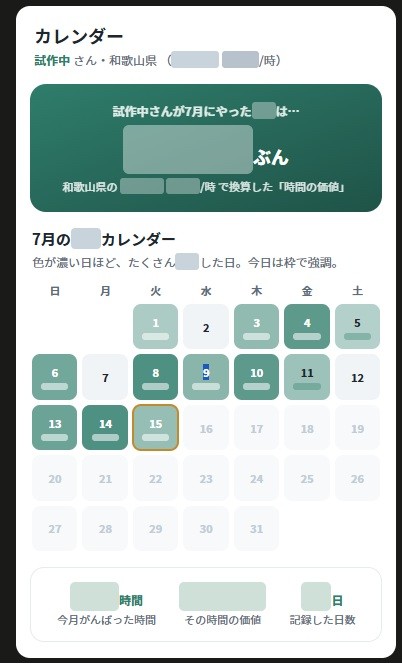
Since the numbers and the text are hidden, I doubt you can tell what kind of app it is. But a screen like that actually runs on my own phone. Press a button and it responds. The data switches. All of that in a single day, and without me writing one line of code.
Honestly, I am the one most surprised by this. Not long ago I assumed an app was something a specialist company spends months building. That it could take shape this quickly, just from a conversation with an AI, was not on my map at all.
What matters is not skill, but “I want it like this”
The thing I felt most strongly from doing this is that what you need when you build something with AI is not programming knowledge.
What you need is the image inside you and the judgement to go with it. “I want something that does this.” “This part should be like that.” If you have that, Kuro fills in the technical gaps. If anything, not knowing the fine details of the machinery may free you up to think about how the person using it will feel.
This is still only a prototype. To turn it into a real app sitting in a store, there is a lot left to get over. Saving data. Review. All the small, careful building. It is a long road.
But the fact that I have started building is, for me, a big step. I set up a blog, I rescued posts that had disappeared, and now an app. With Kuro alongside me, there seems to be plenty more I can do.
As for what the app actually is, I want to introduce it properly on this blog once it exists as a real thing. Until then, please look forward to it.
To be continued.
If you want to read the “rescuing what had disappeared” chapter that came before this one, it is here: recovering lost posts with the Wayback Machine. And if you are curious about how fast an idea can become a working screen, I also wrote about building an app prototype in minutes just by talking.